October 24, 2026 How to Read a Japanese Property Listing: 3LDK and Beyond

October 24, 2026 How to Read a Japanese Property Listing: 3LDK and Beyond
Hello to all our visionary investors, global families, and brave pioneers! Magandang araw po! It is Anna, your bilingual client liaison and content specialist at Anhome. Welcome to another Saturday with us!
■ The numbers and letters that appear on every Japanese property listing
When foreign clients first start searching for properties in Japan online, one of the first things that comes up is a string of numbers and letters attached to every listing something like 3LDK, 4LDK, or 2SLDK. In my role explaining the search process to foreign families, decoding this notation is often one of the first things we do together.
Today I want to walk through what these mean, because once you understand the system, browsing Japanese property listings becomes significantly easier.
■ What the letters stand for
The letters refer to the types of rooms in a home.
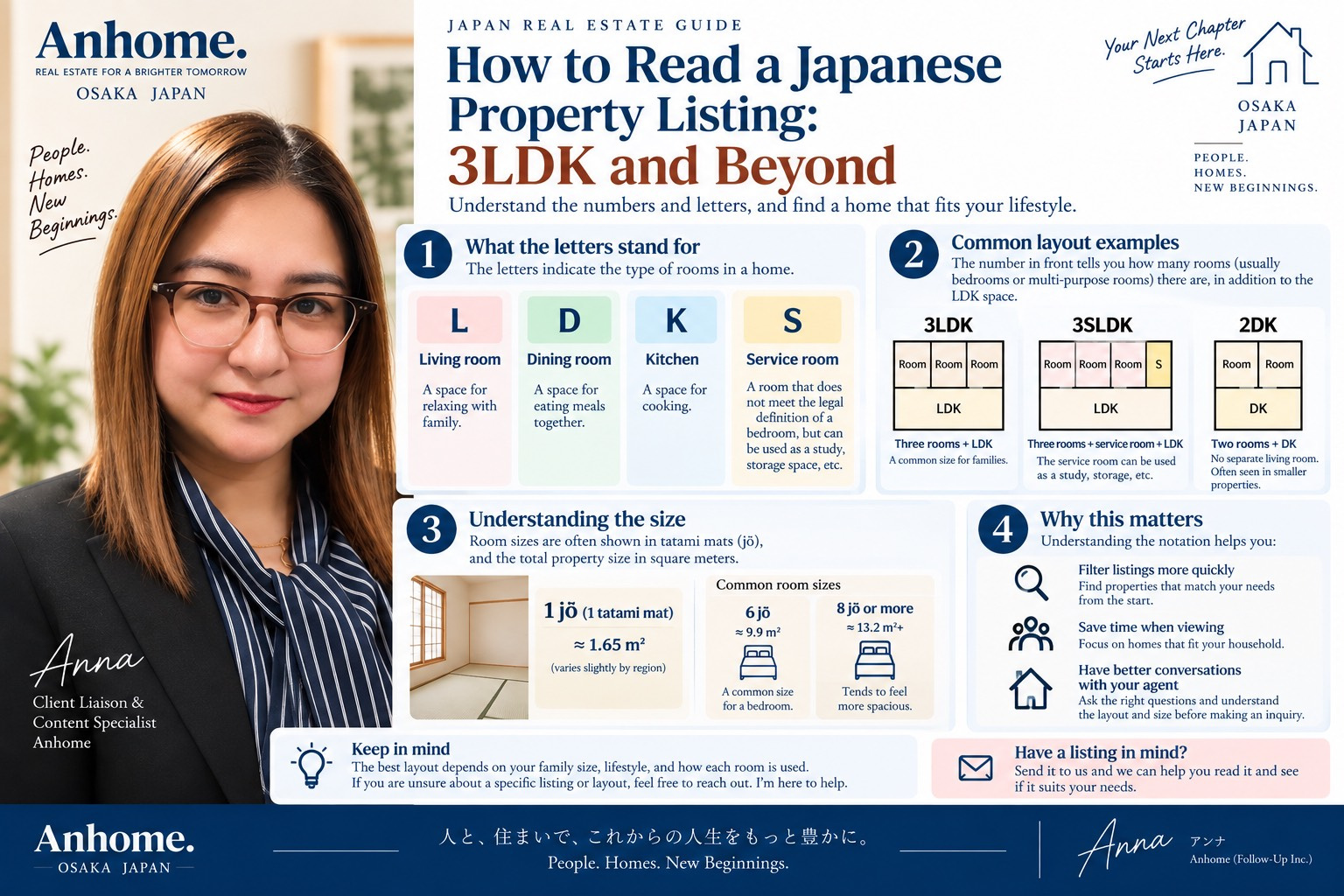
L stands for Living room. D stands for Dining room. K stands for Kitchen. The number in front tells you how many additional rooms typically bedrooms or multi-purpose rooms the property has on top of the living, dining, and kitchen space.
So a 3LDK property has three rooms plus a combined living, dining, and kitchen area. A 4LDK has four rooms plus that combined space. In everyday life in Japan, LDK properties are the most common format for family homes.
■ A few variations worth knowing
Some listings include an S, which stands for Service room a room that does not meet the legal definition of a bedroom due to its size or window conditions, but can still be used as a study, storage space, or children's room. A 3SLDK, for example, has three standard rooms, one service room, and the LDK space.
You may also see DK without the L, which means the dining room and kitchen are combined but there is no separate living area. This tends to appear in smaller properties.
■ The size information that appears alongside it
Japanese property listings typically show room sizes in a unit called tatami mats, or jō one jō is roughly 1.65 square meters, though this varies slightly by region. The overall property size is usually shown in square meters.
When a listing shows the size of individual rooms, the number refers to how many tatami-sized units the room is. A room listed as 6 jō is approximately 9.9 square meters, which is a fairly common size for a bedroom. A room listed as 8 jō or more tends to feel more spacious.
■ Why this matters when you start to narrow down
Understanding the notation means you can filter listings more quickly and spend your viewing time on properties that actually fit your household. A family of four looking for enough space for two children will usually start from 4LDK or a larger 3LDK, depending on how the rooms are sized. Knowing what you are looking at before the first inquiry makes that initial conversation more efficient.
If you are in the early stages of searching and would like help reading a specific listing or understanding whether a particular layout suits your family, that is exactly the kind of question I am here for.
■ Get in touch
I am happy to help you make sense of Japanese property listings in plain English. Reach out any time.
Phone: 072-489-5661
— Anna
Anhome (Follow-Up Inc.)